How do you find the best dog bed?
The wide selection of dog beds on the market can sometimes cause some confusion. Where once there were only dog baskets or dog cushions, there are now almost endless sleeping options, from dog sleeping bags to dog tents, dog benches, and other dog furniture. Since dogs spend most of their lives—approximately two-thirds of their lives and up to 20 hours a day—sleeping, the right dog bed plays a crucial role. Below, you can read what to consider when buying a dog bed to find the ideal one for your dog’s individual needs.
Dog bed, cushion, or basket – how do you find the right sleeping place for your four-legged friend?
The wide selection of dog beds on the market can sometimes be a bit confusing. Where once there were only dog baskets or cushions, there are now almost endless sleeping options, from dog sleeping bags to dog tents, dog benches, and other dog furniture. Since dogs spend most of their lives—approximately two-thirds and up to 20 hours a day—sleeping, the right dog bed plays a crucial role. Below, you can read what to consider when buying a dog bed to find the ideal bed for your dog’s individual needs.
1. The right shape and size
1. The right shape and size
Dog beds come in a wide variety of shapes, styles, and sizes. Round or square, with or without a border. There are few pros or cons to favor or oppose a particular shape, as the choice should be limited to your pet’s preferences. Every animal is different, although some sleeping habits can also be inferred by the dog breed. Over time, you’ll get to know your four-legged friend’s sleeping habits, so you can find the ideal bed for them. Until then, it’s important to observe and learn.
Round dog beds.
Round dog beds, also called dog poufs or donuts, are usually elevated and cuddly soft. They are particularly suitable for dogs that like to curl up. They form a hollow in the center, automatically creating a pleasantly warm edge when you sink into it. Generally, small dogs with a thin undercoat like to curl up, but there are also larger greyhound breeds and border collies that prefer to snuggle up close.
Dog beds and baskets with high edges.
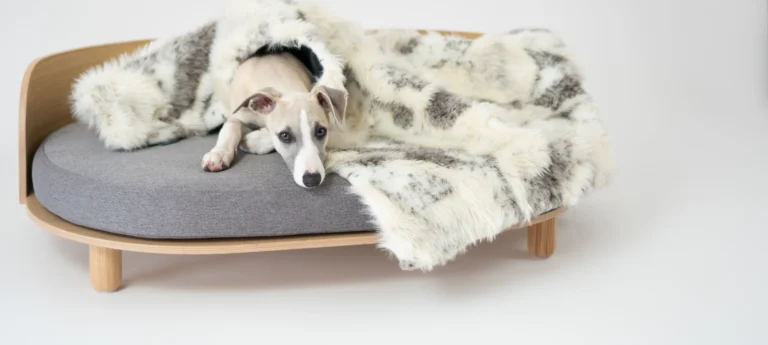
Suitable for all dogs that seek protection and like to lie in corners. They can rest their heads on the edge and observe their surroundings. They are available worldwide in felt, woven basket, leather, faux leather, cotton, or plush; the outer material is then supplemented with soft cushions or mattresses, depending on the manufacturer. These dog beds are suitable for almost all dogs, including Labradors, Poodles, Australian Shepherds, Pugs, and Beagles, but when choosing the size, make sure the dog can still stretch out.
XXL dog beds:
Dogs such as Mastiffs, Rhodesian Ridgebacks, St. Bernards, Bernese Mountain Dogs, Great Danes, and the like need space and, like all other dogs, the most comfortable sleeping surface possible. Depending on the dog’s weight, there are softer or firmer dog beds available, into which the dogs can sink to a greater or lesser extent. These beds are particularly suitable for long dogs that like to sleep on their backs or sides. A border is not necessary; just a spacious, comfortable sleeping area. The rule of thumb here is at least 20 centimeters of extra space to stretch out. Dog beds are also available in versions with varying degrees of elevation, so that the dog always has an optimal view, if desired.
Dog Blankets:
For some dogs, extra coverage on their dog bed is essential, especially in autumn and winter. Cuddle blankets for dogs made of fleece, leashes, or cotton offer security and warmth, so your pet feels comfortable even in the colder months. Blankets can also be used as underlay for the sofa or car to keep pet hair and stains off these surfaces. A personalized dog blanket is also a practical and convenient way to show your dog where their sleeping spot is, based on their familiar scent. This way, they can relax anytime, anywhere.
2. Suitable outdoor materials for dog bed covers
While short-haired dogs love cuddly and fluffy materials like plush or wool, dogs with long fur often prefer smooth materials like cotton or even faux leather. Dogs that get cold easily need soft materials, especially during the colder months, to snuggle up against and stay warm. A dog bed should also always provide insulation against heat and cold. However, it is highly recommended, especially for sensitive dogs prone to allergies, to use natural, untreated materials. For example, outdoor materials made of hemp or organic cotton are available on the growing market, and their natural fibers make them particularly well-tolerated even by very sensitive dogs.
3. Which mattress for which dog?
Every dog bed should be both functional and comfortable. Some manufacturers of inexpensive dog beds use inferior mattress fillings that seem very comfortable at first glance, but don’t adequately support a dog’s sensitive back and joints. In the long run, it’s worth investing in a high-quality, multi-chambered mattress that won’t sag even after years of use and simultaneously protects the joints. Besides foam, cold foam, or latex mattresses, there are also microbead pillows and pillows filled with various flakes. It’s often helpful to inspect a dog bed in a specialty store before purchasing, touch it, and, if possible, even let your dog lie on it for a test run. This is the easiest way to determine whether the filling meets the needs of you and your four-legged friend. For a good night’s sleep, a dog mattress should be stable, sufficiently soft, and quiet. Depending on the dog’s size and weight, mattresses with softer or firmer fillings are recommended. Heavy XXL dogs like Ridgebacks, Labradors, or Great Danes need the firmest possible mattress filling to relieve pressure on their joints and thus prevent joint problems. This also applies to smaller, very muscular dog breeds like French bulldogs, as well as overweight dogs. Sturdy mattresses with dense filling are recommended; if the models are too soft, these four-legged friends may have difficulty standing upright. To ensure that even the smallest dogs can sink into them, mattresses for Chihuahuas, Dachshunds, Maltese, and similar dogs should have softer and less firm filling. These dogs do not thrive on mattresses that are too firm, as they require a certain weight to make the pet on them yield. For optimal comfort and healthy sleeping, it is essential that the dog bed remains stable. Mattresses with chamber systems are a good solution here, retaining their shape for many years. It is also important to consider the special needs of older pets. Because your pet’s movements become increasingly slower and cumbersome, older pets need a dog bed that makes it easy to lie down and get up. The mattress for older dogs should therefore be as weightless as possible and as close to the ground as possible; at the same time, the filling shouldn’t be too soft. This also applies to pregnant female dogs, as their growing offspring can restrict their freedom of movement. Both online and in specialty stores, there’s a wide selection of so-called orthopedic dog beds or health beds. Especially important for dogs with joint problems or arthritis is the relief of the joints when lying down, as well as the prevention of pressure points. This is made possible by dog beds with thick mattresses.These are high-quality and offer strong padding. Another option is memory foam mattresses. It’s also helpful if the mattress is divided into individually padded chambers, as this prevents bedsores.
4. Which dog breeds sleep in which dog bed?
The optimal bed for your four-legged friend simply doesn’t depend on the breed. However, it’s possible to make general recommendations for dogs with long or short fur, and for different sizes. However, every dog is unique with its own needs and thoughts, so even within its own breed, there can be some irregularities. The dog’s breed alone doesn’t tell you anything about the optimal dog bed for your four-legged friend. However, it is possible to make general recommendations for dogs with long or short fur, and for certain sizes. Nevertheless, every dog remains unique with its own needs and sleeping preferences, so even within the same breed, there can be differences. As already mentioned in the points “Right shape and size,” “Suitable outer material for the cover,” and “Which mattress for which dog,” different types of dogs have different sleeping habits. Round dog beds with a soft mattress, for example, are particularly suitable for light dogs that like to curl up. These include Italian Greyhounds, Chihuahuas, Bolonka Zwetnas, Maltese, Jack Russell Terriers, and Dachshunds. Dog beds with a high edge are especially suitable for dogs that seek protection and rest in corners. They are undisturbed there and feel safe, which is especially important for puppies. A flatter edge, on the other hand, allows the head to rest comfortably, allowing them to observe their surroundings at all times. Typical watchdogs such as shepherds or border collies find this particularly pleasant for dozing. Saint Bernards, Bernese Mountain Dogs, Great Danes, Wolfhounds, and other large dog breeds, on the other hand, need space and a sufficiently padded mattress. A firm dog cushion is ideal for these dogs.
5. Dog tents and dog sleeping bags – what for?
Certain dog breeds, through evolution, prefer dark and narrow spaces. Dachshunds, for example, were originally bred to assist with badger hunting. Because a badger’s den is dark and burrow-like, modern dachshunds and related dogs also feel very comfortable in this environment. Therefore, these animals still prefer to bury themselves under blankets or make themselves comfortable in small dog dens and sleeping bags. These types of products are also a popular option for dogs with a thin undercoat or small, easily frostbitten dogs, such as smaller greyhounds or similar breeds. Since other dogs, on the other hand, want to be as present as possible at all times, it’s important to consider, depending on the dog, whether an open bed or a more sheltered version is more suitable.
6. Where is the best place to place the dog bed at home?
For a dog, its people are part of the pack, so the dog bed should be positioned so that the four-legged friend can participate in family life even while sleeping. There should be a fixed place where the animal can relax and retreat – the dog bed should be an undisturbed resting place without constant observation, even if it is close to the pack. The sleeping area should also not be too close to a window or a heater. Too close contact with the heater can dry out the mucous membranes, while drafts cause tension and discomfort. For optimal relaxation, the sleeping surface should never face the front door. Although four-legged friends like to have a good overview of the room, especially alert dogs often cannot get enough rest if the door is in their field of vision. In their opinion, they should eventually pay attention to this. Initially, when the dog has just moved in with you, experts also recommend placing a dog bed in the bedroom for the four-legged friend who is part of the family. This is a particularly quick way to build a bond; It also gives dog owners the chance to recognize when it’s time for a night walk, especially with puppies or animals that are not house-trained, due to restless behavior.
Newsletter Updates
Enter your email address below and subscribe to our newsletter